Oct 23, 2026Flow Meter Selection Guides
Electromagnetic Flow Meter Conductivity: Which Liquids Can It Measure?
An electromagnetic flow meter needs a conductive liquid. What the published 5 µS/cm threshold means for tap water, RO permeate, deionised water and wastewater.
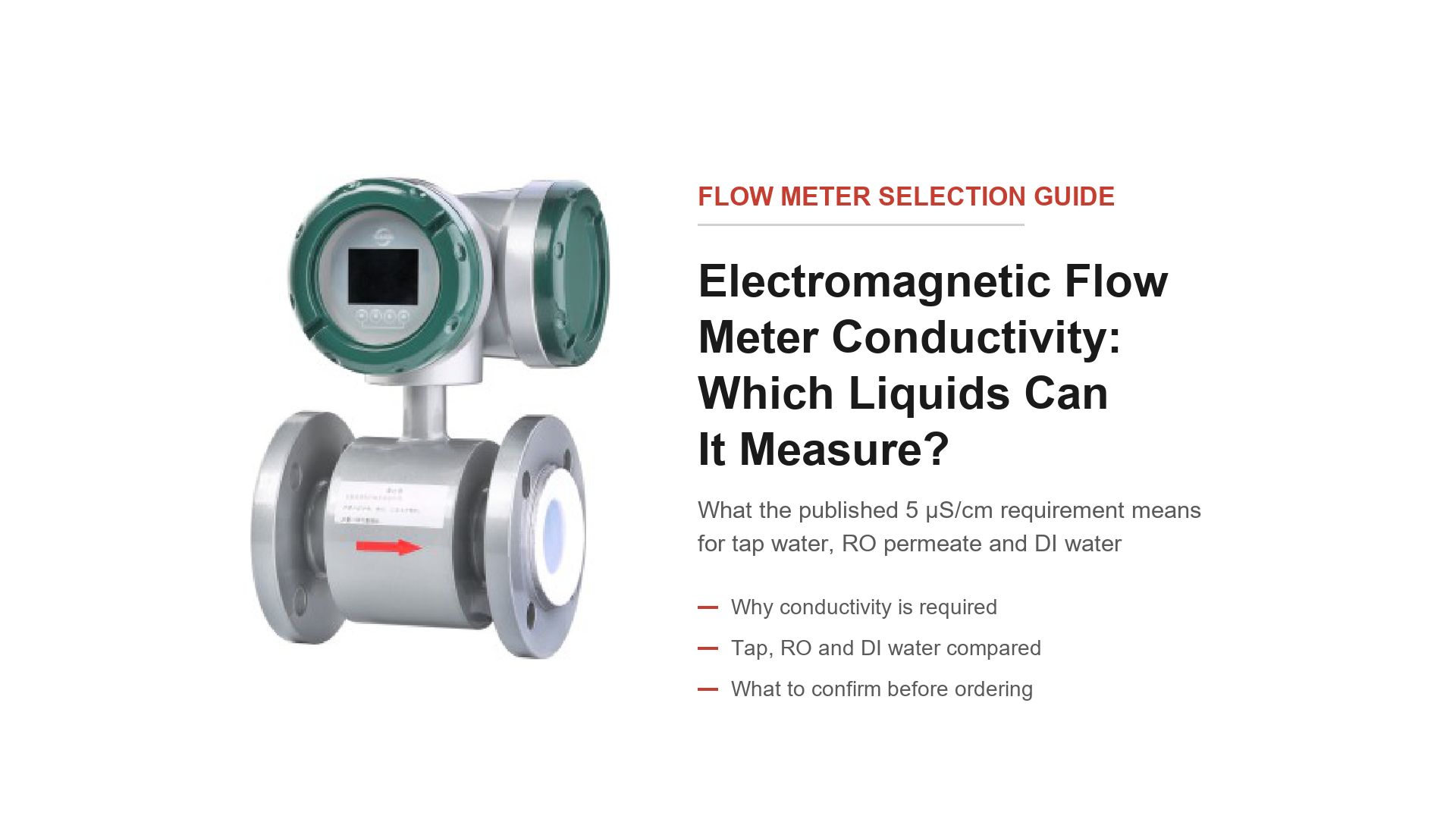
When a buyer shortlists an electromagnetic flow meter, the first technical filter is not pipe size or flow range — it is the liquid itself. Electromagnetic meters are built for conductive liquids, so every enquiry eventually arrives at the same question: is my liquid conductive enough, and what does "conductive enough" actually mean?
For Yuanda's LD series the published figure is a conductivity threshold of 5 µS/cm. This guide explains where that threshold comes from, what it does and does not tell you, and how to judge the liquids buyers ask about most often: tap water, industrial water, wastewater, and the RO and deionised streams that cause the most confusion.
If you are looking for how to size an LD to a pipe and flow range, that is covered separately in How to Select an Electromagnetic Flow Meter by Size and Flow Range. This article is strictly about the medium.
Why an electromagnetic flow meter needs a conductive liquid
An electromagnetic flow meter has no moving parts and nothing protruding into the liquid. It works on Faraday's law of electromagnetic induction: the meter's coils generate a magnetic field across the pipe, the liquid flows through that field, and a voltage proportional to the flow velocity is induced. Two electrodes mounted in the liner wall pick up that voltage, and the converter turns it into a flow reading.
The critical detail is that the liquid itself is the conductor in this measurement circuit. The voltage the electrodes detect is generated in the liquid, and how strong and how clean that signal is depends on how well the liquid conducts. When conductivity is insufficient, the signal available at the electrodes and the signal-to-noise ratio behind it may fall short of what the meter needs to resolve a stable reading — which is why the catalog publishes a conductivity threshold rather than a general preference for "watery" liquids.
This is also why the threshold cannot be tuned away on a standard meter. The meter does not add conductivity to the liquid, and no converter setting changes what the liquid can conduct. If a liquid sits below the published threshold, the duty is outside the meter's documented operating condition and needs to be evaluated as a technology-fit question — not adjusted like a parameter.
One related point is worth stating plainly, because it comes up in enquiries: the fact that an electromagnetic flow meter requires conductivity does not mean the meter comes with a conductivity reading. No independent conductivity measurement output is listed in the published LD documentation. The published outputs — 4–20 mA, pulse and RS485 — carry the flow signal. If your process needs to monitor conductivity itself, that is a separate analytical function.
What the LD catalog publishes — and what it does not
Yuanda's LD series is documented in the 2024 product catalog and on the LD electromagnetic flow meter product pages. On conductivity, the catalog states that the LD works on Faraday's law and is used to measure the volumetric flow of conductive liquids with a conductivity above 5 µS/cm; the online product page states the figure as "Conductivity ≥ 5 µS/cm". The catalog also places the product under the JB/T9248-1999 standard and describes its media scope: general conductive liquids, strongly corrosive liquids such as strong acids and alkalis, and uniform liquid–solid suspensions such as slurry, ore pulp and paper pulp.
Because the two published sources phrase the threshold slightly differently — "above 5 µS/cm" in the catalog, "≥ 5 µS/cm" on the product page — this guide takes the conservative reading: the LD documentation identifies 5 µS/cm as its conductivity threshold, and for preliminary selection you should treat liquid conductivity above 5 µS/cm as the stated condition. Operation at or very near the boundary is a factory-confirmation case, not a datasheet detail to argue over.
That is what is published. It is equally important to be clear about what is not published, because those gaps are where buying decisions go wrong:
Published by Yuanda | Not published (confirm with the factory) |
|---|---|
Conductivity threshold: 5 µS/cm — treat "above 5 µS/cm" as the stated condition | How the threshold behaves at or near the boundary across liner, electrode and temperature combinations |
Media scope: conductive liquids, strong corrosives, uniform slurries | Accuracy and stability guarantees for liquids close to the threshold |
Applicable industries: water treatment, chemicals, paper, food, mining and others | A low-conductivity model — none is listed in the published LD range |
Flow outputs: 4–20 mA, pulse, RS485 | Any conductivity measurement or output — not listed in the published documentation |
Two rows of that table deserve emphasis. First, no low-conductivity variant is listed in the published LD documentation. Special low-conductivity magnetic meters do exist as a distinct product class in the wider market, so if your duty is genuinely low-conductivity, the honest next step is a factory discussion — covering both whether anything in the range fits and what is actually available. Second, no conductivity measurement or output is listed in the published documentation. Both points shape the advice in the rest of this guide.
Does meeting 5 µS/cm guarantee a stable measurement?
No — and it is worth understanding why, because the answer protects you in negotiations as much as in engineering.
Meeting the conductivity condition is the entry ticket. It establishes that the liquid meets the documented precondition for the measurement to work. What it does not establish is the quality of the measurement in your specific installation. That depends on everything that surrounds the liquid: correct meter size and flow velocity, liner and electrode materials matched to the chemistry and temperature, proper grounding and installation position, and a liquid whose conductivity stays within range while the process runs.
The catalog publishes the threshold without qualifying conditions — no temperature reference condition, no per-liner or per-electrode qualification — so questions like "how close to 5 µS/cm can we run before accuracy degrades?" do not have published answers. These are legitimate questions to ask, and the honest answer is supplier confirmation for the specific duty. A supplier who claims the threshold alone guarantees stable measurement under all conditions is overselling a datasheet line.
The practical reading is this: treat conductivity above 5 µS/cm as the first gate the liquid must pass, then verify the rest of the duty on its own merits — and treat readings at or very near the boundary as confirmation cases in their own right.
Tap water, industrial water and wastewater
For ordinary water duties, the catalog itself is reassuring. The LD electrode selection table lists domestic water, industrial water, well water and municipal wastewater among the media suitable for standard 316L stainless steel electrodes, alongside weakly corrosive acids, alkalis and salts. In other words, Yuanda does not treat these waters as edge cases — they are documented, everyday applications for the product family, which is also why municipal water management appears among the catalog's listed industries.
On conductivity specifically, waters of these kinds are, in typical field practice, well above the 5 µS/cm threshold — which is part of why magnetic flow meters are the default technology for potable water, network metering and plant water duties. But that is general engineering experience, not a specification, and it is not a substitute for one measurement of the actual liquid. Demineralised boiler feed water is also "water", and it can sit below the threshold; condensate returned from a process can too. The reliable habit is: one measurement, at the actual line, before you commit to a technology.
Wastewater adds one more consideration, and it is not conductivity. Raw sewage and industrial effluent frequently carry solids, rags and abrasive particles — which is precisely why the catalog extends the LD's scope to slurry, ore pulp and paper pulp. For those duties, the conversation shifts from "can it measure?" to "which liner and electrode survive the medium?", and that is a per-application confirmation covering chemistry, temperature and abrasion.
RO feed, RO permeate, deionised and ultrapure water
Reverse-osmosis duties produce more conductivity confusion than any other application, because an RO system contains several different waters with very different conductivity — and the answer changes depending on where in the loop the meter sits.
The principle is simple: an RO membrane rejects dissolved ions, so the permeate (the water that passes through the membrane) has lower conductivity than the feed, while the concentrate (the reject stream) carries the ions that were removed. How much lower the permeate conductivity is depends on the feed water quality, the membrane condition and the system's rejection performance — which is why a blanket statement like "RO water is measurable" or "RO water is not measurable" cannot be correct, and why each stream is judged by its own measurement.
The practical way to think about each stream:
- RO feed water is essentially your raw water with some pre-treatment. If the raw water met the condition, the feed usually does too — but measure it at the feed line, because pre-treatment dosing can change conductivity.
- RO permeate is the stream that trips buyers up. Its conductivity is lower than the feed by design, and depending on the system a permeate reading can land clearly above the threshold, close to it, or below it. This is a measure-it-at-the-takeoff-point situation, not a name-it-and-assume-it situation.
- Deionised (DI), polished and ultrapure water belong to a different discussion again. The theoretical conductivity of ideally pure water is about 0.055 µS/cm at 25 °C — a general chemistry reference value for perfectly pure water, not a figure for any real water grade. Actual DI and ultrapure water vary with the polishing level and the process stage, and the real value must be measured rather than assumed from the label: grades of purified water can sit well below the threshold, and others sit closer to it. The measured value decides.
On low-conductivity duties specifically: no low-conductivity model is listed in the published LD documentation, and that is exactly what an enquiry will be told rather than being sold a stretched datasheet. If your duty is DI loops, ultrapure distribution, or RO permeate polishing, say so explicitly so it can be evaluated properly — and whether anything beyond the published range is available is a supply question to confirm with the factory, not something to assume in either direction. And if the RO-adjacent duty you actually have is a low-flow sampling or dosing line, we cover a different technology for that case in Acrylic Rotameters for RO Water Systems.
If conductivity is below 5 µS/cm — or unstable
Suppose you measure the liquid and the reading comes back at 3 µS/cm, or it swings between 2 and 20 µS/cm across the week. Neither result automatically closes the case, but both change what should happen next — and what should not happen is a supplier waving it through.
A reading below the threshold calls for three checks before the duty is judged at all. First, confirm the measurement itself: conductivity meters vary, cells foul, and readings are temperature-dependent, so an unqualified number from a poorly matched instrument is weaker evidence than it looks. Second, check where the sample was taken — RO feed and RO permeate from the same system are different liquids, and a sample from a dosed side-stream is not the main process liquid. Third, re-read at the actual liquid temperature, because conductivity shifts with temperature.
If the liquid genuinely measures below 5 µS/cm, a standard LD does not meet its documented operating condition and must not be treated as qualified by default. The duty then needs formal evaluation: whether a different configuration or a different measurement technology fits is an engineering question, and the availability of anything outside the published range needs to be confirmed as a supply matter rather than assumed. If the reading straddles the threshold — sometimes above, sometimes below — that instability is itself process information, and it should go into the enquiry verbatim: minimum, typical and maximum readings, with temperatures. An intermittent sub-threshold condition is exactly the kind of duty that must be confirmed rather than assumed.
The one thing a buyer should never accept is a default "yes" to a below-threshold duty. If a supplier confirms the duty, ask for the confirmation to state its basis — which model, which liner and electrode, at what conductivity and temperature — and keep it with the order.
How to check before you ask
The conductivity evidence in your enquiry is only as good as the measurement behind it. Five habits make it credible:
- Measure at the metering point. The number that matters is the conductivity of the liquid in the line where the flow meter will sit, not at a tank, a laboratory tap or another branch of the plant.
- Use an instrument suited to the range. Low-conductivity liquids need a conductivity meter whose measurement range covers them and whose calibration is current — an instrument selected for general water work may not resolve the region around 5 µS/cm at all.
- Record the temperature with every reading — and say whether it is compensated. Conductivity readings move with temperature: note the actual liquid temperature, and state whether each reading is temperature-compensated to 25 °C. Yuanda's published documentation does not state a temperature reference condition for the 5 µS/cm threshold, so that reference condition is itself a supplier-confirmation item.
- Sample more than once. Batch processes, shift changes and RO systems that cycle all produce liquids whose conductivity moves. Three or four readings spread across normal operation tell you whether the threshold question is settled or borderline.
- Note the instrument. The meter model and cell type let the factory judge the reading's quality — and make your number reproducible if the duty is questioned later.
What this produces is the single most valuable line in an enquiry: a measured conductivity range for the actual liquid at the actual installation point, with the temperature and instrument context a factory needs in order to rely on it.
Common questions before ordering
Our liquid is plain municipal tap water. Is that above 5 µS/cm? Waters of this kind are, in typical practice, well above the threshold, and the catalog lists domestic water among the media suitable for standard 316L electrodes. But that is field experience, not a specification — confirm with one measurement of your line, because the condition attaches to the liquid, not the label.
We run an RO system. Can we meter the permeate? It depends on the measured permeate conductivity at your takeoff point, which the membrane system determines. If the reading sits clearly above 5 µS/cm, the stated condition is met on that evidence and the rest of the duty can be assessed normally. If it lands at or near the boundary, or below it, the duty needs factory confirmation before an order.
Do you have a meter for ultrapure water? No low-conductivity model is listed in the published LD range. Ultrapure water commonly measures far below the threshold — though the governing figure is your measured value, not the name. Special low-conductivity magnetic meters are a distinct product class, and whether anything suitable is available is a supply question to put to the factory directly, with your measured data.
Does the flow meter tell us the conductivity value? No conductivity measurement or output is listed in the published LD documentation. The published outputs — 4–20 mA, pulse, RS485 — carry the flow signal. Process conductivity monitoring is a separate analytical function, and any output requirement beyond the published list should be confirmed with the factory.
Does temperature matter for the conductivity threshold? Yes, in two ways. Conductivity readings themselves shift with temperature, so every reading you record should carry a temperature — and a note of whether it is compensated to 25 °C. The liquid temperature also drives liner and electrode selection, which the catalog tabulates per material. Because no temperature reference condition is published for the threshold, borderline duties should have it confirmed with the factory.
Conductivity varies between shifts. Which value do we use? Use the lowest measured value to test against the threshold, and state the full range — minimum, typical, maximum — in the enquiry. Intermittent operation at or below the threshold is a formal evaluation case, not a footnote.
Requesting a quote for a liquid duty
The fastest way to get a serious answer on any liquid is to put the conductivity evidence in the enquiry from the start. A quote request that already contains the measurements below lets the factory assess the duty on engineering rather than back-and-forth questions — use Get a Quote to send it.
RFQ item | Why it is needed |
|---|---|
Medium and process name | Establishes the application class and the relevant catalog media scope |
Measured conductivity — min / typical / max | Tests the liquid against the published 5 µS/cm threshold; the minimum value governs; readings at or near the boundary are confirmation cases |
Temperature at each reading, and whether compensated to 25 °C | Conductivity is temperature-dependent; the threshold's temperature reference condition is not published and is confirmed case by case |
Sample point (feed / permeate / process line) | Prevents feed-vs-permeate and side-stream misjudgement |
Flow rate range (min / normal / max) | Determines meter size — see the electromagnetic sizing guide |
Pipe size and material | Sizes the meter and flags grounding requirements |
Operating pressure | Checked against the pressure rating for the meter size |
Solids, abrasion or viscosity notes | Drives liner selection for slurry and effluent duties |
Required output (4–20 mA / pulse / RS485) | Matches the converter to your control system |
Integrated or remote construction | Determines signal distance and installation layout — see the LD series overview |
An enquiry with those ten lines gives the factory what it needs to assess the duty properly. Liquids measuring above the threshold can be matched against the published catalog data directly; borderline and sub-threshold duties are routed to technical evaluation, and what comes back is an engineering assessment of that specific case. The electromagnetic flow meter family covers the water, wastewater and corrosive duties described above, and every borderline case goes to the factory before commitment.