Flow Meter Selection Guides
LZT-4T vs LZT-6T vs LZT-8T: How to Choose a Panel-Mounted Acrylic Rotameter
LZT-4T, LZT-6T and LZT-8T are three panel-mount acrylic rotameters with different ranges, connections and scale media. How to pick one and specify it for OEM builds.
Three models, one family, and a buying decision that turns on details most catalogs bury: which flow band you need, whether the scale in front of you is calibrated for water or air, whether the body takes a quick-connect or a threaded fitting, and whether a regulating valve belongs in the order. Get those four wrong and you receive a meter that is well made and unusable on your line.
This guide compares Yuanda's LZT-4T, LZT-6T and LZT-8T — the three panel-mount models in the LZT acrylic series — using only what the 2024 catalog publishes, plus the two product pages that exist for the 4T and 6T. It is written for OEM equipment builders specifying meters into machines, distributors building stock ranges, and buyers comparing quotations that look similar on paper but are not equivalent.
If you are new to acrylic rotameters as a category and want the general orientation first — how a variable-area meter works, what the materials mean, where it belongs — start with the Acrylic Rotameter Selection Guide. If your application is reverse osmosis, the measurement-position questions are covered in Acrylic Rotameters for RO Systems. This article is narrower: three specific models, and how to order one correctly.
What Actually Separates the Three Models
The three models share a construction concept — an acrylic (organic glass) tapered tube with a float, mounted through a panel, read directly off a scale printed beside the tube. Yuanda describes the series as suitable for liquid or gas single-phase, non-pulsating flow, with the practical advantages of light weight, resistance to breakage and long service life.
What separates them is the measurement envelope and the plumbing interface:
- LZT-4T covers the smallest flows and uses a quick-connect fitting. Its liquid ranges are in millilitres per minute; its gas ranges are in litres per minute and top out at 1-12 L/min.
- LZT-6T moves up to tens of litres per hour for liquids, and its gas ranges reach 10-100 L/min — the highest gas ceiling of the three models. It uses an internal ZG1/4" thread.
- LZT-8T has the narrowest liquid range list (three options, in LPH) and expresses its gas ranges in m³/h rather than L/min. That unit change is a conversion problem, not a capacity boast: the top of its gas range, 2 m³/h, is about 33 L/min — a third of the 6T's ceiling.
That last point is where more purchasing errors happen than anywhere else in this family, and it deserves its own section below.
The Three-Model Comparison
Published values only, exactly as the catalog table states them:
| LZT-4T | LZT-6T | LZT-8T |
|---|---|---|---|
Liquid ranges | 6-60, 8-80, 10-100, 40-400 ml/min | 2-20, 4-40, 6-60, 10-100 LPH; 10-70 GPH | 2.5-25, 5-45, 6-60 LPH |
Gas ranges | 0.1-1, 0.25-2.5, 0.6-6, 1-4, 1-10, 1-12 L/min | 0.1-1, 0.25-2.5, 0.6-6, 1-12, 3-30, 5-50, 10-100 L/min | 0.1-1, 0.16-1.6, 0.2-2 m³/h |
Connection | Quick-connect | Internal ZG1/4" | Internal ZG1/4" |
Accuracy | ±4% | ±4% | ±4% |
A (height, mm) | 94 | 102 | 110 |
B (mm) | 28 | 30.6 | 25 |
C (mm) | 21.6 | 25.6 | 25 |
D (mm) | 14 | 18 | 18 |
E (mm) | 14 | M18×1.5 | M18×1.5 |
F (mm) | 70 | 76 | 80 |
Three things about that table are worth stating explicitly, because buyers routinely read past them.
The accuracy figure is published as a single value across all three models — ±4% — and the catalog does not state whether it applies identically to the liquid and gas scales. The product pages for the LZT-4T and LZT-6T describe their figure as ±4% of full scale; that wording should not be extended to the LZT-8T, whose basis is a factory-confirmation item. For any model, if your acceptance testing depends on the exact basis, confirm it for the specific model and scale you are ordering before you write it into a purchase specification.
The GPH option in the LZT-6T liquid column is published as "GPH" without a stated gallon definition. US and Imperial gallons differ by about 20%, so the conversion is not interchangeable. If your duty is specified in gallons, state the gallon definition in the enquiry and have the range confirmed — this guide deliberately does not convert GPH to litres without that basis.
No pressure or temperature rating is published for this panel series. You will find pressure and temperature figures on other Yuanda families, and you will certainly find them on competitor datasheets for similar acrylic meters, but this catalog does not publish them for the LZT panel models. Do not import another supplier's numbers into a specification for these — ask.
The dimension columns are outline dimensions, not a panel cut-out. They describe the meter body. They do not tell you what to punch in your panel. That distinction is covered in the mounting section.
Reading the Range Columns: Liquid vs Gas Is Not the Same Scale
Here is the trap. A quotation lists "L/min" for a meter. Another quotation lists "L/min" for a different meter. The buyer assumes these are comparable. They may not be, because the number only means something together with the medium it was calibrated for — and this family publishes separate liquid and gas range columns for every model, in different units within a single model.
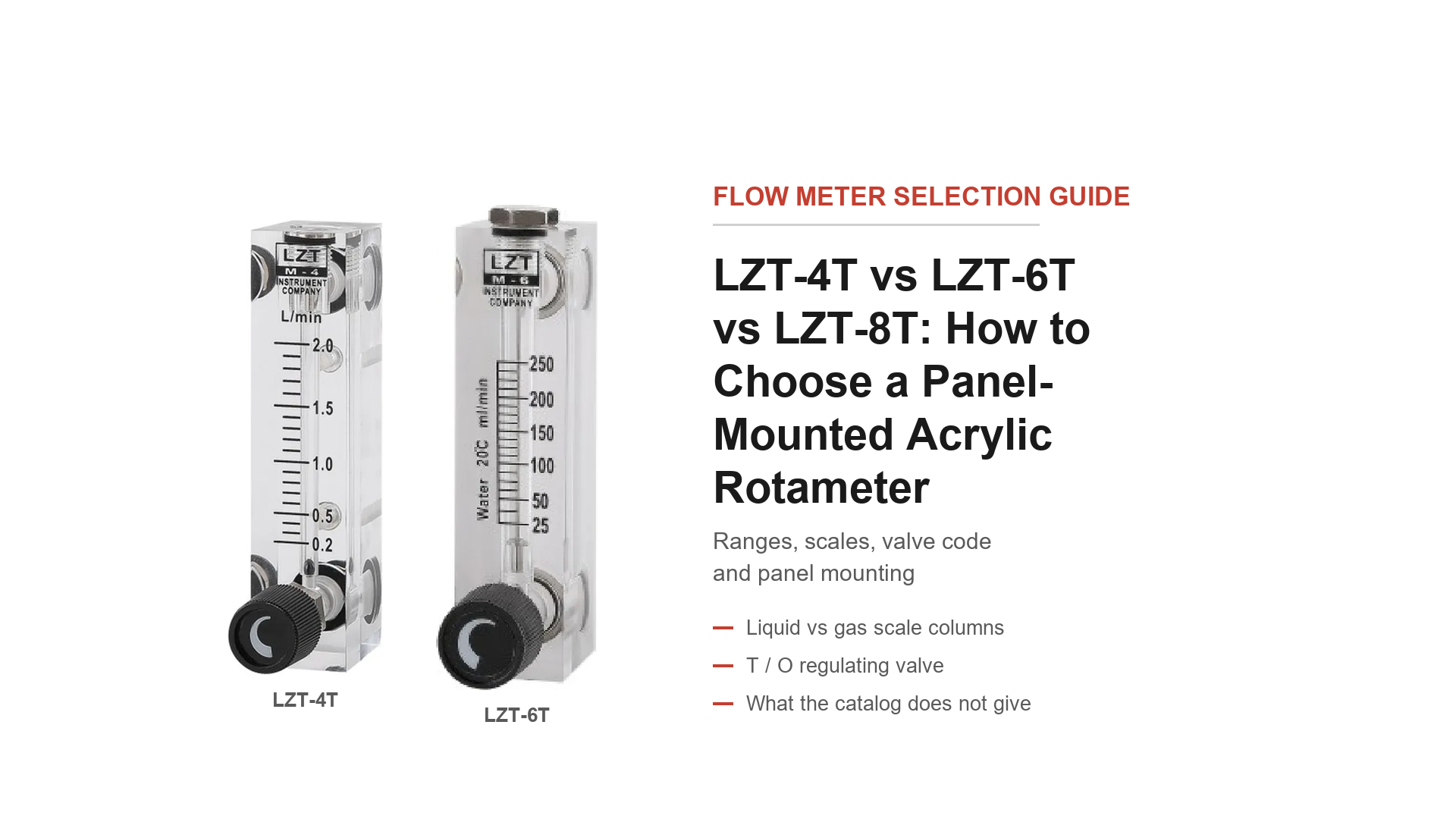
The catalog's product photographs illustrate the point without settling it. The LZT-6T photo shows a scale printed "Water 20 °C ml/min"; the LZT-4T photo shows a "L/min" scale. Those are two different calibration references on two similar-looking acrylic blocks — but read them as they are: examples of what a scale label looks like, not as the complete list of ranges each model can be supplied in. The 6T photograph's ml/min markings do not correspond to the 6T's published LPH/GPH range list, because a photo shows one built meter, while the range table lists the options. They are two different kinds of evidence and should not be merged into a claim about "the 6T's scale".
So when you compare a meter — from a quotation, a photo, or a catalog page — check four things together, not one:
- Liquid or gas — which column the number came from.
- The flow range and its unit — including whether the unit changes between models (it does here: ml/min, LPH, GPH, L/min, m³/h all appear in this one family).
- The calibration medium — water or air, as printed on the scale or stated in the order.
- The reference conditions — a scale marked at 20 °C water, or air at a stated temperature and pressure, is only comparable to another number taken under the same reference.
Where the reference conditions are not published for a given scale, that is a factory question, not something to assume.
This is why the catalog gives every model two separate range columns — one for liquid, one for gas — rather than one list. The LZT-4T does not have "a 6-60 range"; it has a 6-60 ml/min liquid range and, separately, gas ranges starting at 0.1-1 L/min. Note the units differ between the two columns even within one model, and note that 8T switches its gas column to m³/h entirely.
Two practical rules follow:
- Order the medium you are measuring. The model code carries a medium digit — A for gas, W for liquid — and the scale is calibrated accordingly. Specifying a gas duty and receiving a water-calibrated scale (or the reverse) is a meter that reads wrongly, not a meter that needs adjusting.
- Compare quotations by medium, not by unit. If one supplier quotes 1-10 and another quotes 1-10, check which column each number came from before comparing price. A liquid LPH band and a gas L/min band are not the same duty.
If your process flow is pulsating rather than steady — a piston pump discharge, for instance — this family's published scope is single-phase, non-pulsating flow, and that is a technology question rather than a model question.
The T / O Code: When a Regulating Valve Earns Its Place
The model code in this series is built from a model, a valve digit, a medium digit and a range. The valve digit is the one that changes the price and the installation:
- T = with regulating valve — LZT-4T, LZT-6T, LZT-8T as named
- O = without regulating valve
This T/O code is published for the general LZT-4T/6T/8T panel series — the catalog's material-code table for these three models is headed with all three model numbers and lists T/O alongside the medium codes. It is not an oxygen-only option.
The valve is the black knob at the bottom of the meters in the catalog photographs: a needle valve built into the meter body that lets an operator set and hold a flow rate by hand, at the meter. Be precise about what that means, because it is where expectations go wrong: it is a manual adjustment, not a pressure regulator. If upstream pressure changes, the float moves and the reading changes — the valve does not hold a constant flow rate for you. It gives you an adjustment point; it does not give you automatic flow control. Whether you want it depends on what is upstream.
Specify the valve (T) when the meter is the flow-setting device. If the machine has no other flow control on that branch — a sampling line fed from a manifold, a purge line, a small dosing branch — then a meter without a valve gives you a reading you cannot act on without adding hardware elsewhere. The integrated valve turns the meter into the control point.
The valve-less version has its own place. When the flow is already set upstream by a pump speed, a fixed orifice or a system valve, an extra needle valve in the meter body is another component to leave open and another place for an operator to change a setting that was supposed to stay fixed. In that case the O version is the cleaner specification.
Two cautions on this. First, the catalog presents T and O as code options but does not tabulate which of the listed ranges are offered in both variants for every model — treat per-range availability as a factory confirmation. Second, the valve material is itself a code choice: H = brass, 304 = stainless steel. If your medium or your plant standard rules out brass, that is a specification line, not a detail to leave to the default.
Connections and Panel Mounting: What the Catalog Does and Does Not Tell You
The connection difference is real and it is the first compatibility check. LZT-4T uses a quick-connect fitting; LZT-6T and LZT-8T use an internal ZG1/4" thread. If your machine's tubing is already specified — push-in pneumatic fittings, a particular hose barb, a stainless compression fitting — then the connection will strongly influence the model choice, possibly ahead of the flow range. Check it early. Whether a given fitting can be adapted to your tubing is a separate plumbing question worth confirming rather than assuming either way.
The 6T and 8T also publish E = M18×1.5 in the dimension column, while the 4T publishes E = 14 mm. What that dimension is measured across is not labelled in the catalog; see the note below.
On panel mounting, the catalog is explicit about the category and silent on the mechanics. The section heading calls all three models 面板式 — panel type — and the drawings show the body outline. What the catalog does not publish is the panel cut-out drawing, the fixing method, the hole pattern, the panel thickness range, or the installation tolerances. The visible features on the body in the photographs are not a substitute for that drawing; what retains the meter and to what tolerance is a documented question, not something to read off a photo.
So the honest statement for an OEM drawing package is: outline dimensions are published; the panel cut-out, fixing method and tolerances are not — request the formal installation drawing for the exact model. Put that drawing's revision into your machine documentation, because a cut-out that is 1 mm wrong is a scrapped panel, not a return.
On the E = M18×1.5 figure for the 6T and 8T (against E = 14 mm for the 4T): this is published in the dimension column and is best treated as the fitting envelope dimension on those two bodies. The catalog does not label it as an installation interface, so confirm its exact meaning — and any thread standard — with the factory if your panel or tubing depends on it.
If you are building a fixture or a panel for a production run, request the drawing before you release the sheet-metal or the panel machining. It costs one email and saves a production stoppage.
Three Ordering Scenarios Worked Through
These are worked from the published range lists only — no invented capability, and the material defaults are the ones the catalog marks as standard.
Scenario 1 — a laboratory analyser sampling line, water, about 30 ml/min. Only the LZT-4T can reach this band in a usable position on the scale: its 10-100 ml/min liquid range brackets 30 ml/min comfortably inside the band. The 6T's smallest liquid range is 2-20 LPH (≈33-333 ml/min), which starts just above 30 ml/min and would put the duty below the bottom of the scale. The 8T's smallest liquid range is 2.5-25 LPH (≈42-417 ml/min), also clear of it. So for this duty the model is decided by the liquid column alone. The scale here would be the water-calibrated one, and because a sampling line is usually the flow-setting point, the T (with valve) variant is the natural specification. Connection: quick-connect — check that your analyser tubing matches before committing.
Scenario 2 — a packaging machine's air purge, around 40 L/min. The LZT-6T publishes 3-30, 5-50 and 10-100 L/min gas ranges, so 40 L/min sits mid-band on the 5-50 option. The 4T tops out at 1-12 L/min gas and cannot reach it; the 8T's gas column is in m³/h (0.2-2 m³/h ≈ 3.3-33 L/min), which also does not cover 40 L/min. This is a gas-calibrated scale, internal ZG1/4" thread, and if the machine's air is already regulated upstream, the O variant avoids a redundant needle valve.
Scenario 3 — a buyer reads the m³/h line and assumes it is water. This is the scenario that goes wrong most often, so it is worth stating as a trap rather than an example. Suppose a buyer sees "0.2-2 m³/h" against the LZT-8T and assumes it is a water range, because 2 m³/h sounds like a plausible water flow for a small skid. It is not: that is the gas column. The 8T's liquid column is in LPH, with three options of 2.5-25, 5-45 and 6-60 LPH; the widest of those, 6-60 LPH, works out to about 100 to 1000 millilitres per minute, i.e. a top end of about 1 litre per minute. The top of the m³/h gas range, 2 m³/h, is about 33 litres per minute — roughly thirty times that. A buyer who specifies from the m³/h line for a water duty receives a meter built for air. Read the column header, not the number.
OEM Mistakes That Cost a Production Run
- Specifying from one column and ordering the other. The single most expensive error in this family. A gas range used to select for a liquid duty (or the reverse) produces a meter with the wrong scale — it will install and it will read, and the reading will be wrong.
- Assuming the same unit means the same calibration. L/min appears in both the 4T gas column and the 6T gas column, but the 4T's liquid ranges are in ml/min while the 6T's are LPH/GPH. Print the column header next to every number in your BOM.
- Treating outline dimensions as a cut-out. The A/B/C/D/E/F figures are body dimensions. Punching a panel to them will not retain the meter.
- Forgetting that the connection decides the model. If your tubing is quick-connect, the 6T and 8T are out regardless of range; if your tubing is 1/4" threaded, the 4T is out. Check the fitting before the flow band.
- Leaving the valve digit to the supplier's default. T and O are a real configuration difference with a real cost difference. Decide it deliberately — and confirm per-range availability.
- Assuming one seal or fitting material across the family. The general panel series marks chrome-plated brass fittings and NBR O-rings as standard, but the oxygen sub-series publishes brass and FKM as its standard configuration. Standard ≠ uniform across every variant. State your material requirement explicitly.
- Importing another supplier's acrylic pressure and temperature ratings. This catalog publishes neither figure for the panel models. A specification built on a competitor's numbers is not a specification for this product.
- Ordering a production quantity before the cut-out drawing exists. See above: the drawing is the gate, not the datasheet.
- Reading a wide-band scale at the wrong point. These are direct-reading variable-area meters; the float is read at its widest diameter. On the models whose pages state ±4% of full scale (the 4T and 6T), the absolute error band is fixed across the range, so the relative error grows toward the bottom of the band. Treat that as product-specific published detail rather than a family-wide rule, and either way do not size so that your normal flow sits in the bottom tenth of the scale.
Common Buyer Questions
What is the difference between LZT-4T, LZT-6T and LZT-8T? Flow envelope and plumbing. The 4T covers the smallest flows (liquid in ml/min) with a quick-connect fitting; the 6T has the highest gas ceiling of the three at 10-100 L/min and uses an internal ZG1/4" thread; the 8T has the fewest liquid ranges (LPH) and publishes its gas ranges in m³/h (up to 0.2-2 m³/h ≈ 33 L/min) on the same ZG1/4" thread. All three are published at ±4% in the catalog's three-model table.
Which model fits my liquid flow? For liquids, compare against the liquid columns only: 4T in ml/min (6-60 up to 40-400), 6T in LPH/GPH (2-20 LPH up to 10-70 GPH), 8T in LPH (2.5-25 to 6-60). The bands do meet in the middle: the 6T's smallest range, 2-20 LPH, is about 33-333 ml/min, which overlaps the 4T's 6-60 and 40-400 ml/min options. A 40 ml/min water duty could therefore be argued on either model, and the deciding factors become where the normal flow sits on the scale (mid-band reads better than the extreme end) and which fitting your tubing takes — the 4T's quick-connect or the 6T's internal ZG1/4".
Which model fits my gas flow? For gases: 4T up to 1-12 L/min; 6T up to 10-100 L/min (the highest of the three); 8T publishes three ranges in m³/h — 0.1-1, 0.16-1.6 and 0.2-2 — where the largest, 0.2-2 m³/h, is roughly 3.3 to 33 L/min. Convert first, then compare. A duty around 40 L/min lands on the 6T's 5-50 range — the 8T cannot reach it (its ceiling is about 33 L/min) and the 4T tops out at 12 L/min. A duty around 1 m³/h (~17 L/min) is covered by the 8T's 0.2-2 m³/h, and also sits inside the 6T's 10-100 L/min band; choose on which scale gives better resolution at your normal flow and on the fitting your machine takes.
Should I order with or without the regulating valve? With (T) when the meter is the flow-setting point and nothing else on the branch controls flow. Without (O) when flow is already set upstream and you do not want a second adjustment point. Confirm per-range availability with the factory, and specify the valve material (H brass or 304 stainless) rather than accepting a default.
How do I choose between a water and an air calibration scale? By the medium you are measuring, and the model code carries a medium digit: A for gas, W for liquid. Do not compare a water-calibrated number with an air-calibrated number even when both are printed in the same unit. The catalog's photographs show a "Water 20 °C ml/min" scale on one meter and a plain "L/min" scale on another — useful as illustrations of how the label reads, but the authoritative range list is the table, and the calibration medium and reference conditions for your specific order should be stated explicitly and confirmed.
What panel cut-out do I need? Not published. The catalog gives outline dimensions (A through F), which are body dimensions, not the panel opening. Request the cut-out drawing for the exact model from the factory before machining panels.
What are the pressure and temperature ratings? Not published for this panel series in the 2024 catalog. Do not substitute another manufacturer's figures. State your operating pressure and medium temperature in the enquiry and have them confirmed.
Can I use this meter on pulsating flow? The catalog scopes the LZT series to single-phase, non-pulsating flow. A pulsating duty — piston or diaphragm pump discharge, for example — is a flow-condition question to raise rather than a model to select.
Are the three models available as standard products? All three are listed in the official catalog's three-model table, and the LZT-4T and LZT-6T carry detailed product pages on this site. For the LZT-8T, and for any model whose exact configuration matters to your build, confirm the current configuration, availability and installation documentation with the factory — the catalog ranges above are the published ones, and supply status is a per-order question.
What to Send for an OEM or Distributor Enquiry
For a single replacement meter, the model and range are usually enough. For an equipment production project — where the meter goes into a machine build and gets documented — the enquiry needs to carry enough to be quoted accurately the first time:
Enquiry item | Why it matters for this family |
|---|---|
Medium and state (liquid or gas) | Decides which range column applies and sets the A/W medium digit |
Flow range with units, min/normal/max | Must be matched against the correct column; state the unit explicitly |
Whether the flow is steady or pulsating | The series is scoped to single-phase, non-pulsating flow |
Operating pressure and medium temperature | Not published for this series — must be confirmed, not assumed |
Existing tubing/fitting on the machine | Decides 4T (quick-connect) vs 6T/8T (internal ZG1/4") |
Panel or machine interface requirement | Triggers the cut-out drawing request early |
Regulating valve: required or not | T vs O; also fixes the valve material (H brass / 304) |
Seal and fitting material requirement | Standard configuration is not uniform across every variant |
Quantity per machine and expected build volume | For quotation and planning — no published MOQ or lead time should be assumed |
Documentation needed (drawings, certificates) | State it up front so the reply can address it |
Send it through Get a Quote. The LZT acrylic rotameter family page shows the range, and the two published models — the LZT-4T and the LZT-6T — carry their own specification tables. An enquiry that names the medium, the unit, the fitting and the drawing requirement gives the factory everything it needs to quote the right meter instead of the nearest one.