Flow Meter Selection Guides
Electromagnetic vs Turbine Flow Meters for Clean Water: How to Choose
An LD electromagnetic meter and an LW turbine meter both suit clean water. Compare conductivity, cleanliness, flow range and what fails first before you specify.
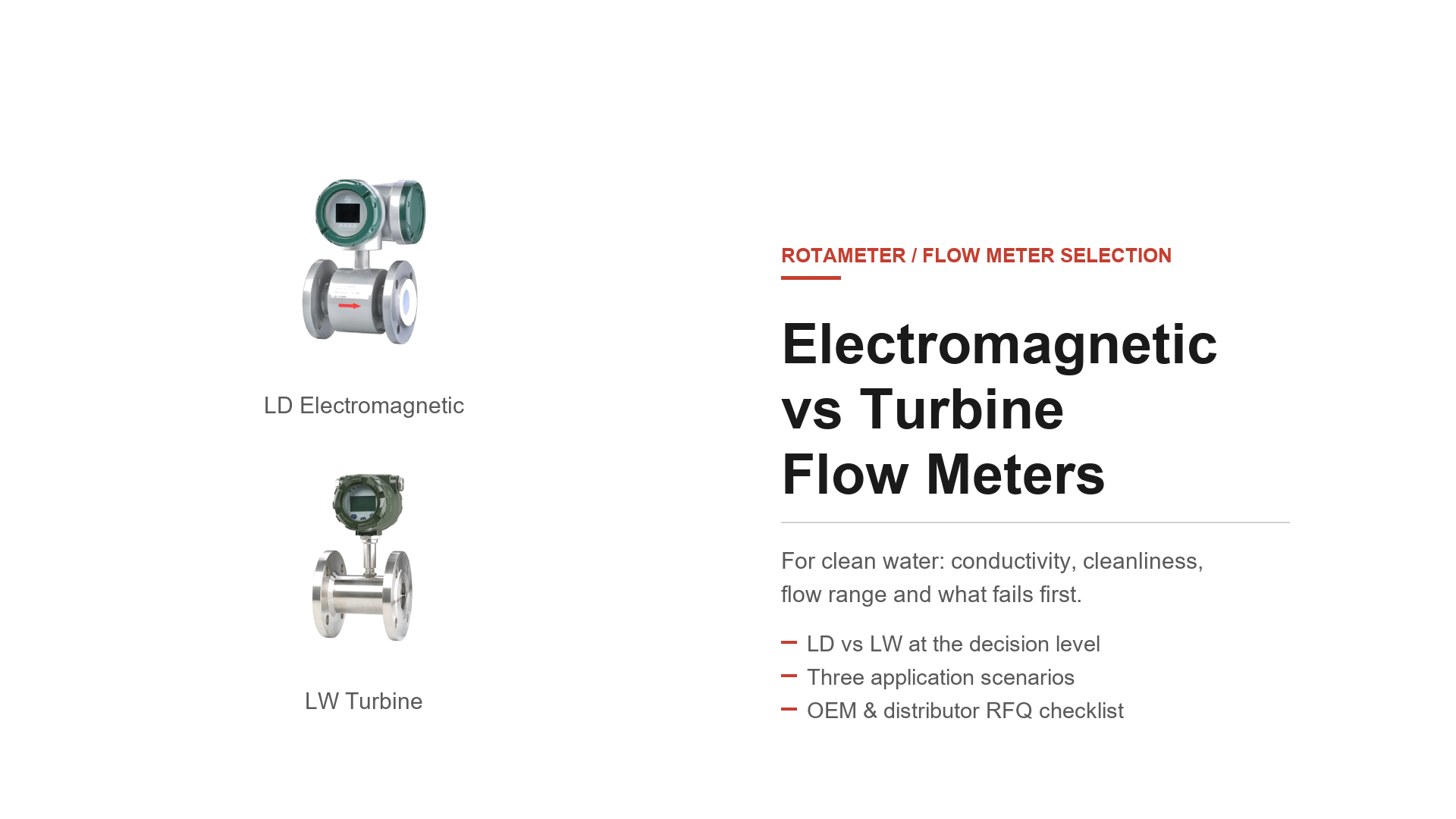
Most clean-water flow meter enquiries stall on the same sentence: "we need a flow meter for water, DN50, about 20 m³/h — which one?" On a clean water line at that size, two Yuanda families are both plausible. The LD electromagnetic meter and the LW turbine meter both measure clean water, and both publish accuracy in the same order of magnitude.
The choice is not about which meter is better. It is about four differences that are visible in the published data before any commercial discussion: whether the liquid passes the conductivity threshold, how clean the liquid actually stays, where the duty sits inside each family's flow range, and what the installation and maintenance environment will tolerate.
This guide works through those four differences using only published Yuanda data for the LD and LW families. It does not re-teach sizing — the companion guides cover LD sizing, LW sizing and LD conductivity in depth. It answers one question: on a clean water duty, which family should be examined first, and what still has to be confirmed before you ask for a price.
Two families, two different measuring principles
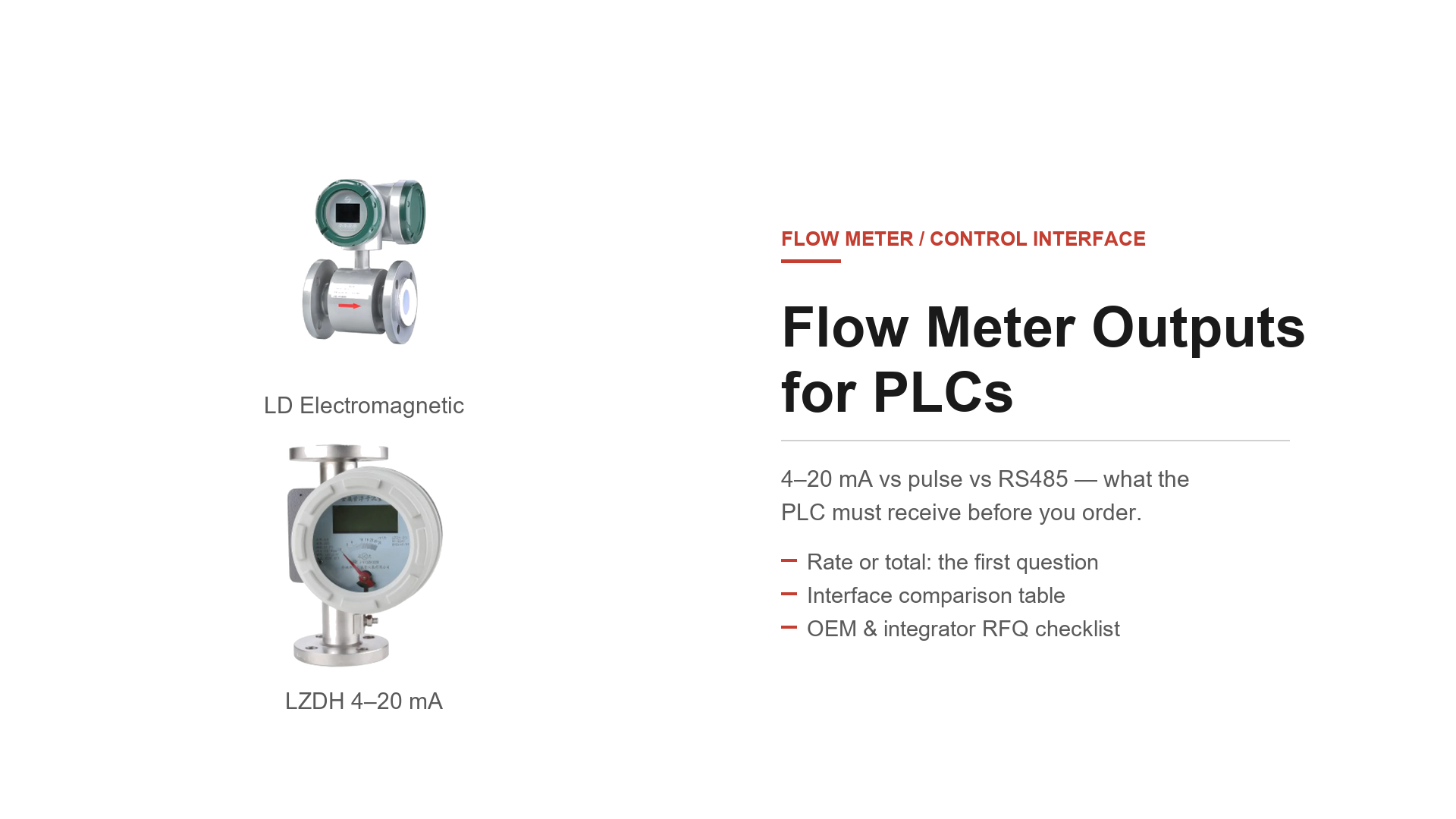
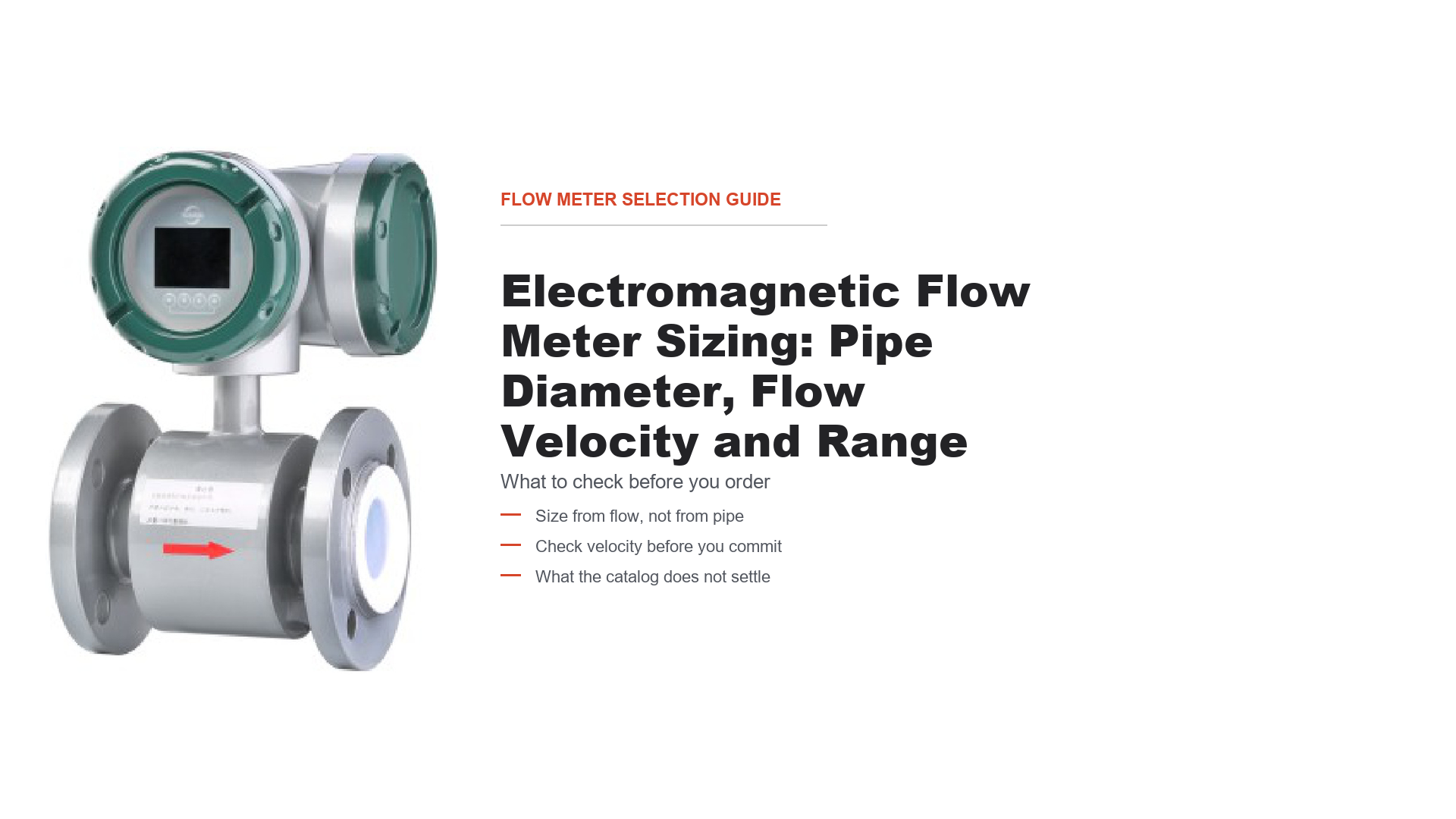
The LD electromagnetic flow meter measures conductive liquid through a lined pipe section with wetted electrodes. The LW turbine flow meter measures a clean, low-viscosity liquid by the rotation of a turbine rotor in the flow stream.
Both are velocity-type meters in the sense that both derive volume flow from the speed of the liquid. The difference that matters commercially is what each one needs from the liquid in order to work at all.
The LD needs conductivity. The LW needs cleanliness. Neither requirement can be negotiated after the fact, and neither can be corrected by calibration.
Difference 1: conductivity, and where it stops mattering
The LD catalog states a minimum medium conductivity of 5 µS/cm. That figure is published for the family, and it is the first filter to apply: below it, an electromagnetic meter is not the right instrument regardless of size, range or output.
For most clean water duties this threshold is passed with wide margin. Tap water, municipal supply, cooling water, process water and most wastewater sit far above 5 µS/cm. The conductivity question therefore usually resolves in one line rather than becoming a design study.
It becomes decisive in the other direction. Deionised water, ultrapure water and some condensate streams sit at or below the threshold, and there the electromagnetic family stops being an option. That boundary is examined in detail in the companion conductivity guide, including what to do when a reading is unstable rather than simply low. If your process water is the output of a reverse-osmosis stage, measure it rather than assuming — RO permeate conductivity varies with the feed water and the membrane stage, and no single published figure covers it.
The LW does not publish a conductivity requirement, because it does not need one. A turbine meter is mechanical: the rotor turns because liquid pushes it. Conductivity is irrelevant to whether it turns. For a low-conductivity clean liquid, that is the structural advantage of the turbine family — a duty that fails the LD filter may still be a perfectly ordinary turbine application.
Difference 2: cleanliness, and how each family degrades
The LW catalog is explicit that the medium must be a clean, low-viscosity liquid. This is not a preference; it describes the operating principle. A turbine rotor sits in the flow path on bearings, and anything that can wear, coat or jam it changes the relationship between rotor speed and volume.
The LD has more tolerance here, and the published options reflect it. The catalog lists liner materials of chloroprene rubber, polyurethane, PTFE, PFA and F46, and electrode materials of 316L, Hb, Hc, Ti, Ta and Pt. It also states the meter can handle strongly corrosive liquids and homogeneous liquid-solid two-phase suspensions such as slurry, ore pulp and paper pulp.
Read that comparison carefully, because it is easy to over-read in both directions:
The LD's tolerance comes from material selection, not from indifference to the liquid. A slurry duty with the wrong liner and electrode will fail as surely as a turbine in the same service.
The LW's cleanliness requirement is about the rotor and bearings specifically. "Clean" here means free of abrasive solids, fibres and material that can deposit — not "potable" in the regulatory sense.
For a genuinely clean water line, neither constraint binds, and the decision moves to the next two differences. For anything with suspended solids, the LD family is the one to examine first, and the liner/electrode selection becomes the real content of the enquiry.
Difference 3: flow range and where the duty sits
This is where the two families separate most clearly in the published data, and where most mis-specified enquiries originate.
Size coverage differs at both ends. The LD covers DN15 to DN2200. The LW covers DN4 to DN200. A DN10 duty has no LD option; a DN300 duty has no LW option. Those two boundaries settle a surprising number of enquiries immediately.
Inside the overlap, the ranges are not interchangeable. Both families publish flow ranges per nominal size, and both expect the normal duty to sit inside the published range rather than at its edge. Because the two ranges are built on different principles, a size that is comfortable for one family may sit below the usable minimum for the other at the same nominal diameter.
Two practical consequences follow:
Size on flow, not on pipe. Matching the meter's nominal size to the pipe diameter is the most common cause of an under-reading installation. This is examined separately in the turbine sizing guide, and the same logic applies here.
Check the minimum, not only the maximum. Most enquiries quote a maximum flow. The failure mode is nearly always a duty that spends its working life below the meter's published minimum, where neither family reads reliably.
Velocity gives a cross-check for the LD. The catalog publishes a normal velocity range of 0.3 to 5 m/s, with an extended range shown to 10 m/s. For a given DN, that velocity band converts into a flow range that can be compared directly against the quoted duty. A duty that requires the meter to sit persistently outside the normal velocity band is a signal to change size — not to accept a marginal selection.
Difference 4: installation and maintenance
The two families place different demands on the installation and on whoever maintains the line.
Installation. The LD requires the pipe to run full at the measuring point and needs a suitable earth reference; the catalog publishes installation position rules covering location relative to pumps, valves and ferrous or magnetic equipment. The LW is a compact in-line body with flange, thread or clamp connections, and the catalog publishes the connection options across DN4 to DN200.
The LD converter can be integrated with the sensor or supplied as a split (remote) type. That matters where the electronics cannot sit in the process environment: the split version publishes IP68 protection and a medium temperature rating up to 150 °C (rubber liner ≤ 80 °C), against IP65/IP67 and ≤ 120 °C for the integrated type. Where the line runs hot or wet, the split configuration is the published route.
Maintenance. The LW has a rotor and bearings in the flow path, which is the source of its published accuracy on clean liquids and also its maintenance exposure. The LD has no moving parts in the flow path; the parts that see the liquid are the liner and electrodes, so what degrades is determined by the liquid's chemistry and by the earth reference rather than by mechanical wear.
For a buyer specifying equipment that will run unattended for years, this difference in what can fail is often more decisive than the difference in stated accuracy.
Accuracy: why it does not settle the choice
Both families publish accuracy in the same band. The LD publishes ±0.5% to ±1.0% depending on configuration. The LW publishes 0.5% or 1.0% by size and type. The LD's figure is tied to the electronics and the liner/electrode configuration; the LW's is tied to the nominal size and to which of its two accuracy classes the model belongs.
Because the headline numbers overlap, accuracy is a poor discriminator between the families and a good reminder of two separate points:
A published accuracy class describes the meter against a reference, not against your installation. Straight run, full pipe, earth reference and flow profile determine whether the installed meter delivers the class on the data sheet.
On the LW, the product page states that accuracy is 0.5% or 1.0% by size and type without publishing a flow range against each class. So the class you need and the flow range you can use are not independent decisions, but the page alone does not let you read the coupling. The published LW flow range table is set out by nominal size with a separate column per accuracy class, and it is reproduced and analysed in the companion turbine sizing guide — check the duty against the column that matches the class you are ordering.
Neither point makes one family more accurate. They make the selection procedure different.
Output and power: read the published options, not the family name
Both families publish output and supply options, and in both cases the family name does not determine what the meter can do.
LD: 4–20 mA, frequency or pulse, and RS485. Power supply 220 VAC or 24 VDC.
LW: pulse, battery-powered local display, and intelligent output versions; integrated or split mounting.
On the LW output list, one point needs care. The published LW page names pulse, battery-powered display and "intelligent output" versions, but it does not spell out which signals the intelligent output supports. It would be wrong to read "intelligent output" as a published 4–20 mA capability. If your requirement is a continuous analogue loop, confirm the signal type against the specific LW model before ordering; do not infer it from the family description.
Two practical cautions follow from that list. First, an RS485 port on a data sheet is not by itself a statement about protocol compatibility with your PLC or SCADA — confirm the protocol before assuming integration. Second, a battery-powered variant changes the maintenance model, so an unattended site and a battery-powered meter need to be checked against each other rather than assumed compatible.
Where the control room needs a continuous analogue value, the LD publishes 4–20 mA as a standard output option; on the LW, confirm the signal type against the specific model as described above. Where the requirement is a discrete limit contact, that is a different question and is not answered by either family name.
Quick comparison: LD vs LW at the decision level
Every row below is drawn from published data for the two families. No family-wide maxima are implied.
| LD Electromagnetic | LW Turbine |
|---|---|---|
Measuring principle | Conductive liquid through lined pipe with wetted electrodes | Rotor turned by a clean, low-viscosity liquid |
Liquid requirement | Conductivity ≥ 5 µS/cm | Clean, low-viscosity liquid |
Nominal sizes | DN15–DN2200 | DN4–DN200 |
Published accuracy | ±0.5% to ±1.0% (by configuration) | 0.5% or 1.0% (by size and type) |
Velocity basis | 0.3–5 m/s normal; extended to 10 m/s | Not published as a family velocity band |
Medium temperature | ≤ 120 °C integrated; ≤ 150 °C split (rubber ≤ 80 °C) | −20 to +100 °C |
Pressure rating | By size and configuration — confirm for the ordered size (see note) | 6.3 / 2.5 / 1.6 MPa by size |
Max pressure loss | Not published as a family figure | 0.025–0.08 MPa by size |
Wetted materials | Liners: chloroprene, PU, PTFE, PFA, F46. Electrodes: 316L, Hb, Hc, Ti, Ta, Pt | Not itemised on the product page — confirm by model |
Output | 4–20 mA / frequency or pulse / RS485 | Pulse, battery-powered display, intelligent output |
Power | 220 VAC or 24 VDC | Depends on variant — confirm by model |
Protection | IP65/IP67 integrated; IP68 split | Not published as a family figure |
Mounting | Integrated or split (remote) converter | Integrated or split; flange, thread or clamp |
What decides against it | Low or unstable conductivity; hot line beyond split limits | Solids, fibres or coating in the liquid; duty outside DN4–DN200 |
Note on the LD pressure rating. The published pressure rating varies with nominal size and configuration. Confirm the exact rating for the size and configuration you are ordering rather than relying on a family-level figure.
Three situations, three different answers
A municipal or process water line, DN80, 30 m³/h, clean liquid. Both families can cover the duty and both publish accuracy in the same band. Neither the published pages nor any installation data collected here establishes that one family is easier to install than the other, so that is not a sound basis for deciding. What the published data does separate is what can fail: the LW has a rotor and bearings in the flow path, the LD does not. Where the site's maintenance practice favours no rotating parts in the line and the liquid conducts, the LD is the family to examine first. Where the line is genuinely clean and a compact in-line body suits the pipework, the LW is equally viable and the choice then turns on the flow range, the pressure loss and the output signal — all of which are published per size and must be checked against the duty.
A DN10 or DN15 clean water duty at low flow. The LD starts at DN15, so below that the family is out of scope by size alone. Even at DN15, a low-flow duty needs the LW's published range for that size checked against the working minimum rather than the pipe diameter.
A line with suspended solids, or a low-conductivity stream. These two failures point in opposite directions and are worth separating. Suspended solids rule the turbine out and point to the LD with a liner and electrode selected for the duty. Low conductivity rules the LD out and leaves the turbine as structurally viable, provided the liquid is otherwise clean. A duty that is both low-conductivity and solid-laden fits neither family as published, and that is a case to raise with the factory rather than to force into a selection.
Common selection mistakes
Sizing on pipe diameter. The meter's nominal size follows the required flow range. A DN50 line running at a flow better suited to DN25 will under-read with either family.
Quoting only the maximum flow. The minimum and normal flow decide whether the meter reads at all. Both families publish a lower bound, and both are sensitive to operating below it.
Assuming the two families are interchangeable above 5 µS/cm. Passing the conductivity threshold makes the LD viable; it does not make the two families equivalent on range, maintenance or pressure loss.
Treating "clean water" as a complete specification. Cleanliness, conductivity, temperature, pressure and flow range are five separate checks. A buyer who supplies only the phrase "clean water" will usually receive a question back.
Assuming an RS485 port guarantees PLC compatibility. Confirm the protocol, not just the port.
Frequently asked questions
Can the LW measure water with low conductivity? Yes — a turbine meter does not depend on conductivity. It depends on the liquid being clean and low-viscosity, so low conductivity alone is not a disqualifier. Confirm the liquid is free of solids and that the duty sits inside the published range for the size.
Can the LD handle slightly dirty water? The catalog states the family can measure homogeneous liquid-solid two-phase suspensions such as slurry and paper pulp, which requires the liner and electrode to be selected for that duty. "Slightly dirty" is not a specification; the solids content, particle nature and chemistry decide the liner and electrode.
Which family is more accurate? On the published figures, neither is systematically better. LD is ±0.5% to ±1.0% by configuration; LW is 0.5% or 1.0% by size and type. Installed accuracy depends more on installation conditions than on the family.
Do both families offer 4–20 mA? The LD publishes 4–20 mA as a standard output option. The LW publishes pulse, battery-powered display, and intelligent output versions, so a 4–20 mA requirement should be confirmed against the specific LW model rather than assumed from the family.
What if my line is DN10 and the liquid does not conduct? The LD does not cover DN10, and low conductivity rules it out on principle. A DN10 non-conductive clean liquid duty is a turbine question, subject to the published DN4–DN200 range and the cleanliness requirement.
Can I use one family everywhere to simplify spares? Only if every duty passes that family's own filter. Standardising on the LW fails as soon as a line carries solids or falls outside DN4–DN200. Standardising on the LD fails on low-conductivity streams. The filter comes first; spares policy comes second.
RFQ checklist for OEM builders and distributors
Send these lines and the quotation becomes a configuration confirmation rather than a technical conversation.
Item | Why it decides the family |
|---|---|
Liquid name and chemistry | Drives conductivity eligibility and, for the LD, the liner and electrode |
Conductivity value (measured, not assumed) | The LD's 5 µS/cm threshold is a hard filter |
Solids content and particle nature | Decides whether a turbine is viable at all |
Minimum / normal / maximum flow, with units | Must sit inside the published range of the chosen size and class |
Nominal pipe size and connection | Flange, thread or clamp; flange standard for the LD |
Operating pressure | Compared against the published rating for the exact size |
Operating temperature | Also decides integrated vs split on the LD |
Required output | 4–20 mA, pulse or RS485 — confirmed per model, not per family |
Power supply available | 220 VAC or 24 VDC on the LD; variant-dependent on the LW |
Integrated or split mounting | And cable length if split |
Installation environment | Wet, hot, or space-constrained conditions that force a split converter |
Existing plant standard | What the site already stocks and maintains |
Initial order quantity | For quotation |
Estimated annual or repeat requirement | For planning — no published MOQ or lead-time policy should be assumed |
Send it through Get a Quote. Each family has its own page with the published data: LD Integrated Electromagnetic and LD Split Type Electromagnetic, plus the LW Flanged Turbine Flow Meter.
For the model-level depth behind this decision, the companion guides cover each family separately: electromagnetic flow meter sizing, electromagnetic conductivity requirements, integrated vs remote electromagnetic and liquid turbine flow meter sizing.